Have you ever wanted to say no but still ended up saying yes?
Have you found yourself agreeing to something, even as a part of you felt resistance?
Do you ever walk away from these moments feeling drained, slightly resentful, and wondering why it was so hard to just say what you actually wanted?
In my clinical practice, these are not rare experiences. I hear versions of this almost every day. “I knew I didn’t want to do it but I couldn’t say no.” And when we slow it down together, it becomes clear that this is rarely about the situation itself. It is about what saying no means. For many people, it does not just feel uncomfortable or inconvenient. It feels wrong. There is often a tightening in the chest, a wave of guilt, and a familiar internal voice:
“You’re being selfish. You’re hurting them. You’re not a good person.”
So instead, they say yes. Repeatedly. Even when they are exhausted. Even when they do not want to. And over time, that yes turns into resentment, emotional fatigue, and a quiet disconnection from the self. If this feels familiar, I want to say this clearly, both from my work as a psychologist and from what I have witnessed across so many stories: There is nothing wrong with you. This pattern makes sense.
Why Saying “No” Feels So Heavy
Working with clients across South Asian contexts, I have seen how deeply our understanding of “goodness” is tied to relationships. We are raised to value respect, harmony, and emotional responsibility toward others. These are beautiful values. But alongside them, many of us internalize something more rigid: Being a good person means being available, agreeable, and accommodating. So when you try to set a boundary, it does not feel like a neutral choice. It feels like you are breaking an internal rule. That is where the guilt comes from. Not because you are doing something wrong, but because you are doing something unfamiliar.
Understanding the Guilt Response
In therapy, I often help clients reframe guilt in these moments. What feels like guilt is often your nervous system reacting to a shift in pattern. If saying yes kept the peace growing up, if being accommodating helped you feel accepted, if prioritizing others protected your relationships, then your system learned: this is how we stay safe.
So when you say no, your mind is not saying, “This is bad.” It is saying, “This is different.” And different can feel threatening, even when it is healthy.
Boundaries vs. Barriers
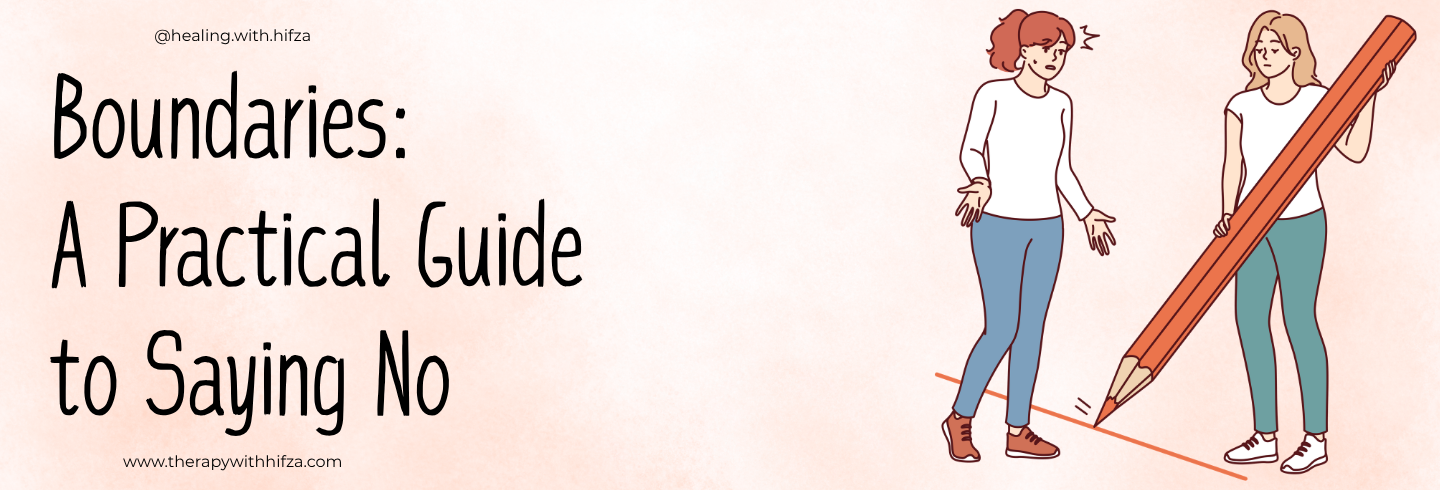
One of the most important distinctions I explore with clients is the difference between boundaries and barriers. Boundaries are about clarity. They communicate what you can and cannot hold, while still leaving room for connection. Barriers are usually built from hurt or fear. They are rigid, defensive, and often disconnecting.
For example:
- A boundary sounds like: “I won’t be able to take this on right now.”
- A barrier sounds like: “Don’t ask me for anything again.”
One protects your capacity while staying connected. The other protects you by creating distance.
The goal is not to remain endlessly open. It is to stay connected without abandoning yourself.
Why Boundaries Feel Like Disrespect
This is something I see often, especially in family systems where hierarchy and obedience are emphasized. When you begin setting boundaries, the response is not always understanding. You might hear:
- “You’ve changed”
- “You’re becoming difficult”
- “This isn’t how we raised you”
And I have seen how quickly this creates doubt in clients. So I say this often in sessions, and I want to say it here too: Setting a boundary is not rejecting a person. It is expressing a limit. Healthy relationships can hold that, even if it takes time for others to adjust.
Saying “No” Without Over-Explaining
A pattern I frequently notice is the need to justify boundaries in order to feel allowed to set them with long explanations, excessive apologies, and trying to make the other person fully understand so the guilt goes away. But here is what I gently remind people: A boundary does not become valid only when it is understood. It is valid because it is yours and you can be kind and clear at the same time. Sometimes, simple is enough:
- “I won’t be able to make it.”
- “I need to sit this one out.”
- “I don’t have the capacity for this right now.”
What I See Happen Over Time
When clients begin practicing boundaries, the initial phase is almost always uncomfortable. The guilt can get louder before it softens. Some people push back. Dynamics shift. But when they stay consistent, something changes. They feel less resentful, their relationships become more honest and they begin to trust themselves more. Most importantly, they experience what it feels like to show up without being emotionally depleted.
Redefining What It Means to Be “Good”
If your definition of being a good person has always included self-sacrifice, then of course boundaries will feel like betrayal. But part of the work I do with clients is expanding that definition.
What if being a good person also meant:
- Being honest about your limits
- Taking care of your emotional capacity
- Showing up without silent resentment
Because in my experience, boundaries do not damage relationships. Unspoken exhaustion does.
Where This Work Begins
This does not start with big, confrontational conversations, it starts with awareness.
- Noticing when you say yes but mean no
- Noticing the tension after you agree to something
- Noticing when you override your own needs to keep things smooth
- And then, gently, trying something different.
Not perfectly. Not all at once. But consistently enough that your system begins to learn: I can take care of myself and still stay connected. That is not selfish. That is sustainable.